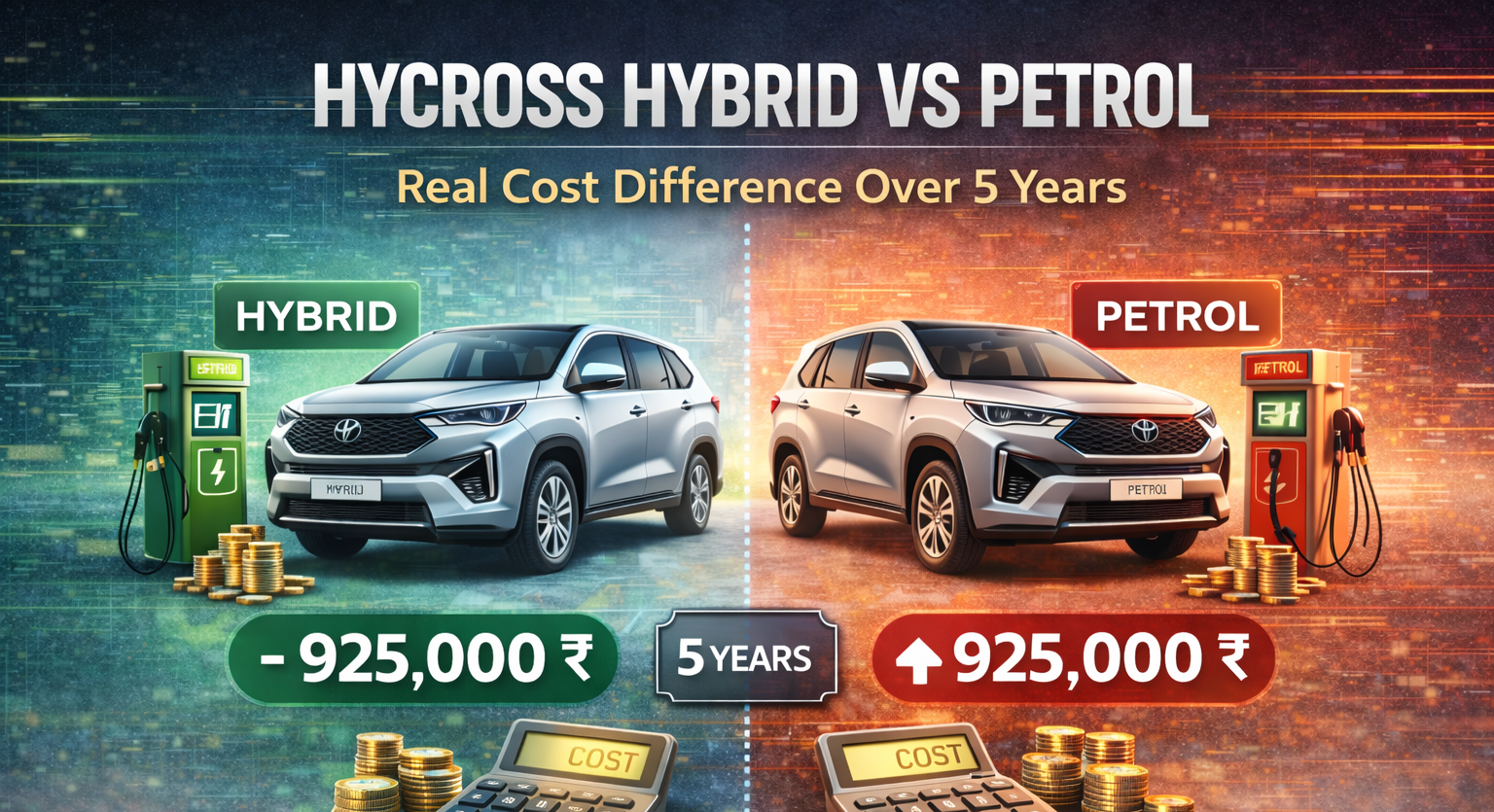
Claimed Mileage vs Real World – What Toyota Won’t Tell You
ARAI-certified figures look great on a brochure. Petrol: 16.13 kmpl. Hybrid: 23.24 kmpl. In the real world, both fall significantly short.Autocar India tested both in peak summer with AC running – which is how most Indian families actually drive. The petrol returned 6.9 kmpl in the city and 12.4 kmpl on the highway. The hybrid did 13.1 kmpl in the city and 16.1 kmpl on the highway. (Source: Autocar India real-world fuel efficiency test)The gap between them in tested conditions: roughly 5 kmpl. That’s still significant – the hybrid covers an extra 250 km on a full tank. But here’s what most guides skip. If you’re mostly on highways at 100+ kmph, the hybrid advantage shrinks. The electric motor contributes most at low speeds and in stop-go traffic. On a clear highway, both run predominantly on petrol.Tested Mileage: Petrol vs Hybrid Side by Side
| Driving Condition | Petrol (Real-World) | Hybrid (Real-World) |
|---|---|---|
| City – peak AC | 6.9 kmpl | 13.1 kmpl |
| Highway | 12.4 kmpl | 16.1 kmpl |
| Overall Average | ~9.7 kmpl | ~14.5 kmpl |
| ARAI Claimed (for reference) | 16.13 kmpl | 23.24 kmpl |
Source: Autocar India instrumented test – peak summer, AC on throughout
 City driver or highway driver?
If you drive mostly in Mumbai, Delhi, or Bangalore traffic – the hybrid advantage is real and consistent every single day. If you do three highway trips a year and mostly garage the car, the gap narrows significantly and the petrol starts making more financial sense.
City driver or highway driver?
If you drive mostly in Mumbai, Delhi, or Bangalore traffic – the hybrid advantage is real and consistent every single day. If you do three highway trips a year and mostly garage the car, the gap narrows significantly and the petrol starts making more financial sense.
The 5-Year Cost Breakdown – Real Rupees, Real Driving
Let’s build the actual math. Here are the assumptions – adjust for your own situation:- Monthly driving: 1,500 km
- Annual driving: 18,000 km
- Petrol price: ₹105/litre (current average, Maharashtra/Karnataka)
- Mileage used: real-world tested figures – not ARAI claims
Step 1 – Annual Fuel Cost Calculation
Petrol variant: 18,000 ÷ 9.7 kmpl = 1,856 litres/year 1,856 × ₹105 = ₹1,94,845/yearHybrid variant: 18,000 ÷ 14.5 kmpl = 1,241 litres/year 1,241 × ₹105 = ₹1,30,345/yearAnnual saving with hybrid: ₹64,500 Over 5 years: ₹3,22,500 saved on fuelStep 2 – Full 5-Year Total Cost of Ownership
| Cost Head | Petrol GX(O) | Hybrid VX |
|---|---|---|
| Ex-showroom price | ~ ₹20.71 lakh | ~ ₹26.50 lakh |
| Hybrid upfront premium | – | + ₹5.79 lakh |
| Fuel cost (5 years) | ~₹9.74 lakh | ~ ₹6.52 lakh |
| Fuel saving (hybrid) | – | – ₹3.22 lakh |
| Service cost (5 years) | ~ ₹1.00 lakh | ~ ₹0.85 lakh |
| Net 5-Year Gap | – | ~ ₹2.72 lakh more expensive |
Source: Toyota service cost data, Spinny ownership cost analysis
 The Numbers Verdict:
After 5 years at 1,500 km/month, the hybrid still costs about ₹2.5-3 lakh more in total – even after fuel savings. Breakeven is around 7-8 years.
The Numbers Verdict:
After 5 years at 1,500 km/month, the hybrid still costs about ₹2.5-3 lakh more in total – even after fuel savings. Breakeven is around 7-8 years.
The Price Premium Also Buys You a Completely Different Car
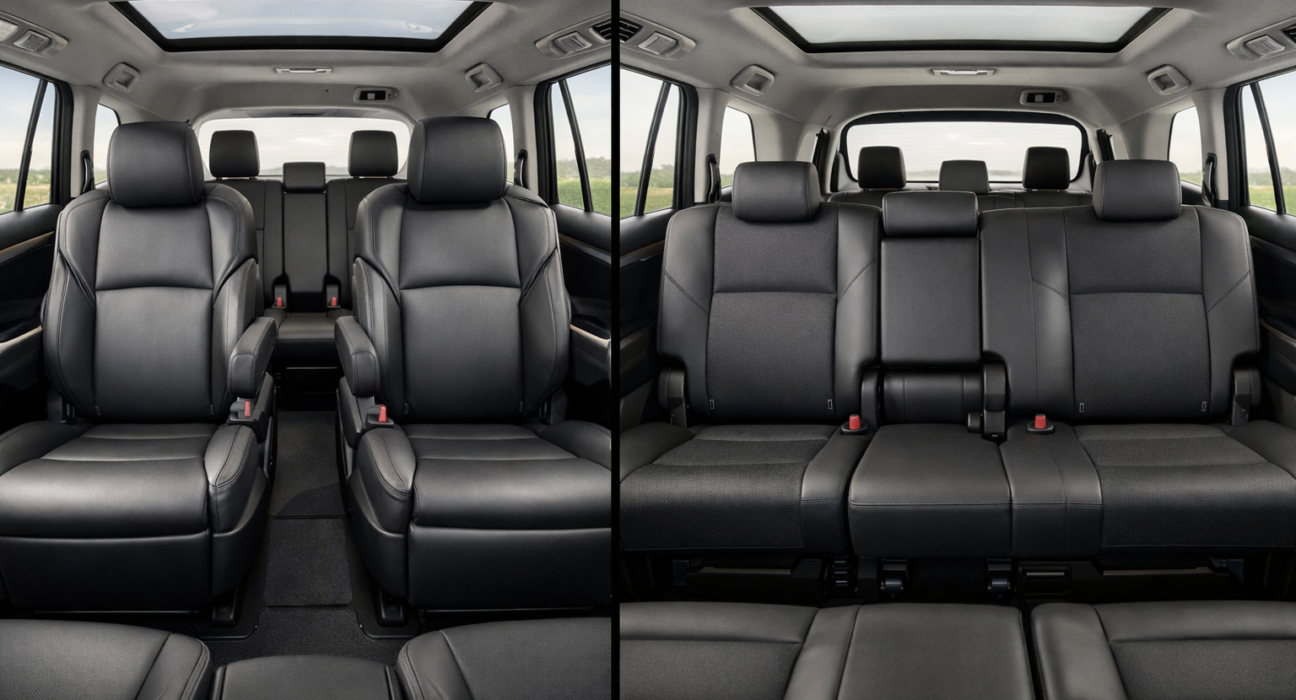
Here’s what the pure cost calculation misses completely.The petrol Hycross is only available in G and GX variants. No panoramic sunroof. No JBL speakers. No ventilated front seats. No powered tailgate. No dual-zone climate control. No ADAS. No 10.1-inch infotainment. Hard black plastics inside, dummy buttons where features should be.The hybrid starts at VX trim – and it’s a genuinely different car. Soft-touch brown-and-black interior, captain seats with ottomans on ZX, 18-inch alloys, full LED lighting, wireless Apple CarPlay, panoramic sunroof, 360-degree camera. The cabin feels like a premium MPV. The petrol feels like a base family car at ₹20 lakh.Autocar India said it plainly: buyers spending over ₹20 lakh for the petrol Hycross will be let down by its rudimentary interiors and missing features.Feature-by-Feature: What You Get and What You Don’t
| Feature | Petrol (G/GX) | Hybrid (VX/ZX) |
|---|---|---|
| Infotainment screen | 8-inch, wired | 10.1-inch, wireless |
| Captain seats + ottoman | ✗ No | ✓ ZX/ZX(O) |
| Panoramic sunroof | ✗ No | ✓ ZX/ZX(O) |
| Ventilated front seats | ✗ No | ✓ Yes |
| Powered tailgate | ✗ No | ✓ Yes |
| JBL sound system | ✗ No | ✓ Yes |
| Level 2 ADAS | ✗ No | ✓ Yes |
| Alloy wheel size | 16-inch | 17-18 inch |
| Interior quality | Hard plastics | Soft-touch premium |
 Think of it this way:
If you’re comparing the petrol GX(O) to the hybrid VX and the gap is ₹5-6 lakh – that ₹5 lakh is also buying you a panoramic sunroof, JBL speakers, ventilated seats, wireless CarPlay, ADAS, and a 10.1-inch screen. At that point it’s not a fuel decision. It’s a features decision.
Think of it this way:
If you’re comparing the petrol GX(O) to the hybrid VX and the gap is ₹5-6 lakh – that ₹5 lakh is also buying you a panoramic sunroof, JBL speakers, ventilated seats, wireless CarPlay, ADAS, and a 10.1-inch screen. At that point it’s not a fuel decision. It’s a features decision.
What About the Hybrid Battery – Is It a Risk?
This is the question every family buyer asks in the showroom. “What if the battery fails after 5 years?” It’s a fair concern. And the answer is more reassuring than most people expect.Toyota offers an 8-year warranty on the hybrid battery in India. The 1.6 kWh NiMH battery in the Hycross uses the same chemistry Toyota has deployed globally since the 1990s – in Prius, Camry, and Corolla hybrids that regularly cross 2 lakh km without replacement.The hybrid system requires no special maintenance. No external charging. No plug. Service costs run slightly lower in practice because regenerative braking reduces wear on conventional brakes.Busting the Biggest Hybrid Battery Myth
 Myth: “The hybrid only works for 5 km on electric power.”
 Fact: The electric motor isn’t meant to drive you 5 km and stop. It cycles constantly – engaging during low-speed city driving, regenerating during braking, assisting the petrol engine during acceleration. Toyota says 50-60% of an urban commute can happen without the petrol engine running at all. That’s what saves fuel.
Buy the Hycross Hybrid If:
- You drive 1,500 km or more per month, mostly in the city
- This is a chauffeur-driven car and rear passenger comfort is the priority
- You want the full premium experience – sunroof, JBL, captain seats, ADAS
- You’re planning to own the car for 7+ years
- You’re buying ZX or ZX(O) and want the complete feature list
- Fuel prices in your state are above ₹105/litre (Maharashtra, Karnataka)
Buy the Hycross Petrol If:
- Your monthly driving is under 1,000 km
- You mostly do highway trips rather than city stop-go
- Budget is a hard constraint and the feature gap doesn’t bother you
- You need the 8-seater bench layout at GX trim level
- The car is for school runs and occasional use, not daily long-distance
How long does the Hycross hybrid battery last?
Toyota offers an 8-year warranty on the hybrid battery in India. The NiMH battery in the Hycross is the same technology Toyota has used globally since the late 1990s – many units cross 2 lakh km without replacement. If replacement is needed after warranty, cost is typically ₹1.5-2.5 lakh at a Toyota authorised service centre.Does the Hycross petrol have the same features as the hybrid?
No – and this is the most critical point most buyers miss. The petrol Hycross is only available in G and GX base trims. It misses panoramic sunroof, JBL speakers, ventilated front seats, captain seats with ottoman, wireless Apple CarPlay, 10.1-inch infotainment, dual-zone climate control, and Level 2 ADAS. The petrol is a genuinely different, entry-level product – not simply a cheaper version of the hybrid.At what monthly mileage does the Hycross hybrid break even?
At 1,500 km/month and ₹105/litre petrol, the hybrid saves around ₹64,500/year in fuel. Against a ₹5.71 lakh upfront premium, breakeven takes approximately 7-8 years. At 2,500 km/month, breakeven drops to 4-5 years. High-mileage urban commuters, cab owners, and chauffeur-driven families recover the premium fastest.Final Takeaway
The Hycross hybrid vs petrol comparison isn’t really about the engine. It’s about which product you’re actually buying.- At 1,500 km/month, the hybrid saves ₹3.2 lakh in fuel over 5 years – but the gap doesn’t fully close until year 7-8.
- The petrol Hycross is a base-trim family mover. The hybrid is a premium chauffeur-driven MPV. At ₹20+ lakh, most families want the latter.
- Heavy city mileage, elderly passengers, or 8+ year ownership? The hybrid is the right call. Lower mileage or a tight budget? The petrol is perfectly rational.
 More Hycross Guides on UpdateDecoded:
- Hycross 7-Seater vs 8-Seater – What’s Actually Different?
- All Hycross Variants Explained: Which One to Buy? (Coming soon)
- Hycross ZX vs ZX(O) – Is ADAS Worth ₹1.5 Lakh Extra? (Coming soon)
- Innova Hycross vs Innova Crysta – Which Should You Buy? (Coming soon)
- Best 7-Seater MPVs in India Under ₹30 Lakh – 2025 Ranked (Coming soon)