What Is a Schengen Visa and Who Needs It?
A Schengen visa from India allows you to travel to 29 European countries on a single visa — without applying separately for each country. Once you have it, you move freely across the Schengen Area just like a European citizen does.As an Indian passport holder, you need a Schengen visa to visit every country in the Schengen Area. There is no visa on arrival for Indians. However, if you already hold a valid multiple-entry US, UK, or Canadian visa, some countries outside the Schengen Area — like Georgia and Serbia — let you enter without a Schengen visa specifically. For the Schengen Area itself, though, you must apply in advance.| Schengen Region | Countries Covered |
|---|---|
| Western Europe | France, Germany, Belgium, Netherlands, Luxembourg, Switzerland, Austria, Liechtenstein |
| Southern Europe | Italy, Spain, Portugal, Greece, Malta |
| Northern Europe | Denmark, Finland, Sweden, Norway, Iceland, Estonia, Latvia, Lithuania |
| Central and Eastern Europe | Czech Republic, Slovakia, Slovenia, Hungary, Poland |
Types of Schengen Visa
| Visa Type | Purpose | Duration |
|---|---|---|
| Tourist / Short Stay | Leisure, sightseeing, family visits | Up to 90 days |
| Business | Meetings, conferences, trade fairs | Up to 90 days |
| Medical | Treatment at a European hospital | Duration of treatment |
| Transit | Passing through a Schengen airport | Up to 5 days |
| Multiple Entry | Frequent travellers — valid 1 to 5 years | 90 days per 180-day period |
Which Country’s Embassy Should You Apply To?
This is the most common source of confusion — and getting it wrong means an immediate rejection or a resubmission delay. The rule is straightforward.For example, if your 15-day trip includes 8 nights in France and 7 nights in Italy, apply to the French embassy. France is your main destination.
For instance, if you spend 5 nights each in France, Germany, and Italy — and enter Europe via Frankfurt — apply to the German embassy.
For example, Iceland is represented by the Danish embassy in India for visa purposes.
Documents Required for Schengen Visa from India
Every Schengen country requires the same core documents. However, some embassies ask for additional items depending on the purpose of your visit. Here is the complete list for a tourist visa application from India.| Document | Requirement | Notes |
|---|---|---|
| Valid Passport | Mandatory | Min. 3 months validity after return date, 2 blank pages, issued within last 10 years |
| All Previous Passports | Mandatory — India specific | Missing old passports is a top 3 rejection reason for Indians |
| Schengen Visa Application Form | Mandatory | Fill online on VFS Global or embassy website. Print and sign all pages |
| Passport-Size Photos | Mandatory | 2 photos, 35x45mm, white background, face covering 70–80% of frame, taken within last 3 months |
| Travel Insurance | Mandatory | Minimum €30,000 medical coverage, valid for all Schengen countries, covers entire trip duration |
| Flight Bookings | Mandatory | Book a refundable “dummy ticket” — do not book non-refundable flights before visa approval |
| Hotel / Accommodation Bookings | Mandatory | Confirmation for every night of stay. Use refundable bookings from Booking.com |
| Bank Statements | Mandatory | Last 3 to 6 months. Must show consistent balance — not sudden large deposits |
| Employment Proof | Mandatory | Leave approval letter, employment letter on company letterhead, or business registration |
| Cover Letter | Mandatory | Day-wise itinerary, purpose of travel, return commitment to India. Keep to one page |
| Income Tax Returns (ITR) | Strongly Recommended | Not always mandatory but significantly strengthens your application |
| Property / Asset Proof | Recommended | Home ownership, vehicle registration, fixed deposits — shows strong ties to India |
| Marriage / Birth Certificate | If applicable | Required if travelling with family. Apostilled if asked |
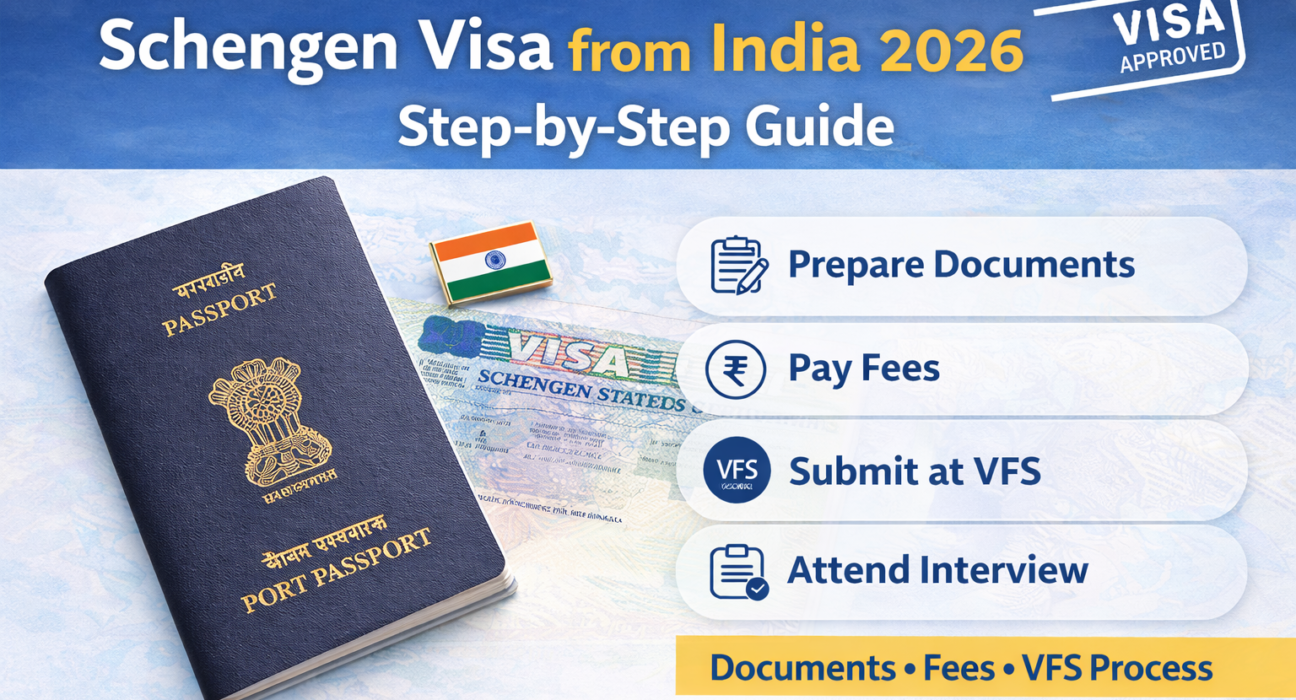
Step-by-Step Schengen Visa Application Process from India
Choose the country where you will spend the most nights. That country’s embassy or VFS centre will process your application. For instance, if you spend 10 nights in Spain and 3 nights in Portugal, apply to the Spanish consulate.
Go to visa.vfsglobal.com and select your destination country and nearest city. VFS Global has centres in New Delhi, Mumbai, Bengaluru, Chennai, Hyderabad, Ahmedabad, Pune, Kolkata, and Chandigarh. Book well in advance — slots fill up fast during April to August peak season.
Complete the form on the VIDEX website or the specific embassy portal. Print all pages including barcodes. Sign the declaration of true information and the travel insurance declaration separately.
Use the checklist above. Organise documents in the same sequence — visa officers process hundreds of applications daily. A clean, ordered file makes a difference. Ensure every date, name, and detail is consistent across all documents — even a minor mismatch causes delays.
Arrive on time with all original documents and their copies. At the centre, you will submit documents, give your fingerprints and photograph (biometrics), and pay the visa fee. Biometrics are collected once every 59 months — so if you gave fingerprints for a previous Schengen visa within 59 months, you may not need to submit again.
After submission, track status through the VFS Global portal using your reference number. Processing begins after biometrics are submitted. Most applications are decided within 15 to 30 days. However, during peak season, this can extend to 45 days.
Once your visa is approved, VFS sticks the visa sticker inside your passport and notifies you for collection. Courier delivery is also available at an additional charge. If your visa is rejected, VFS provides a written reason — you can reapply after addressing the specific issue.
Schengen Visa Fees from India in 2026
The Schengen visa fee increased in June 2024 and the new rate applies in 2026. Here is the complete cost breakdown for Indian applicants.| Applicant Type | Embassy Fee | Approx. in INR | VFS Service Charge | Total Approx. |
|---|---|---|---|---|
| Adults (12+ years) | €90 | ₹8,500 to ₹9,600 | ₹1,500 to ₹2,500 | ₹10,000 to ₹12,100 |
| Children (6–11 years) | €45 | ₹4,200 to ₹4,800 | ₹1,500 to ₹2,500 | ₹5,700 to ₹7,300 |
| Children under 6 | Free | ₹0 | ₹1,500 to ₹2,500 | ₹1,500 to ₹2,500 |
Source: VFS Global India, European Commission — March 2026. INR equivalent varies daily with exchange rate.
Bank Balance and Financial Proof — The Numbers That Matter
Bank balance is one of the most scrutinised parts of a Schengen visa application from India. Embassies want to see that you can fund your trip independently without overstaying.| Trip Duration | Minimum Balance Recommended | Notes |
|---|---|---|
| 7 days | ₹35,000 to ₹63,000 | ₹5,000 to ₹9,000 per day depending on country |
| 10 days | ₹50,000 to ₹90,000 | Most common trip length for Indian tourists |
| 15 days | ₹75,000 to ₹1,35,000 | Higher for Western Europe — France, Switzerland |
| 30 days | ₹1,50,000 to ₹2,70,000 | For a full 90-day stay, 3x this amount is safer |
Source: SchengenVisaSupport.com, March 2026
The Schengen visa is not just a travel document — it is a trust exercise. The embassy is asking one question: will this person come back to India when their visa expires? Everything in your application — your bank balance, your job, your property, your family ties — must answer that question with a confident yes.
Processing Time and When to Apply
Standard Schengen visa processing from India takes 15 to 30 working days. However, during peak travel season — April through August — processing can stretch to 45 days for some embassies. Here is exactly when to apply based on your travel date.| Travel Date | Apply By | Why |
|---|---|---|
| June, July, August travel | April — 8 to 10 weeks early | Peak season — VFS slots and processing both slow down |
| October, November travel | August — 6 to 8 weeks early | Post-peak but still busy for autumn travel |
| December travel | October — 8 weeks early | Christmas and New Year travel is heavily booked |
| January to March travel | November — 6 weeks early | Off-peak season — faster processing |
Tips to Avoid Rejection — What Visa Officers Look For
Most Schengen visa rejections from India are avoidable. Here are the specific reasons applications get rejected — and how to prevent each one.| Rejection Reason | How to Avoid It |
|---|---|
| Missing old passports | Submit all previous passports including expired ones |
| Sudden large bank deposit | Maintain consistent balance for 3 to 6 months |
| Inconsistent documents | Every date, name and detail must match across all documents |
| Weak ties to India | Include employment letter, property documents, family photos |
| Vague cover letter | Write a day-by-day itinerary with specific hotels and activities |
| No travel insurance | Always include — minimum €30,000 coverage is mandatory |
| Non-refundable flight booked | Use a dummy refundable ticket for the application |
| Applied to wrong embassy | Apply where you spend the most nights |
New 2026 Rules — EES and ETIAS You Must Know
Two new European border systems affect Indian travellers in 2026. Both are important — and most Indian applicants do not know about them yet.EES — Entry/Exit System (Active from 2026)
The Entry/Exit System (EES) is now rolling out across Schengen borders. Under EES, every non-EU traveller’s biometric data — fingerprints and photograph — is collected at the border on entry. The system automatically tracks how many days you have spent in the Schengen Area against your 90-day limit. As a result, overstaying your visa is now virtually impossible to do accidentally — and impossible to hide. (Source: European Commission, 2026)ETIAS — Expected Late 2026
ETIAS (European Travel Information and Authorisation System) is a pre-travel authorisation for visa-exempt travellers. Since Indians require a Schengen visa anyway, ETIAS does not directly apply to you. However, it affects transit planning and the overall border process across Europe.The Bottom Line
- Apply for your Schengen visa from India at least 6 to 8 weeks before travel — book your VFS appointment first, since slots run out fast in peak season. Apply to the embassy of the country where you spend the most nights.
- Your two strongest application assets are consistent bank balance over 3 to 6 months and a clear day-by-day cover letter. Submit all old passports — missing even one is a top rejection reason for Indian applicants.
- In 2026, the new EES border system is live — it records your entry and exit biometrically at every Schengen border. Overstaying your visa is no longer just a policy violation — it is tracked automatically and affects every future visa application globally.