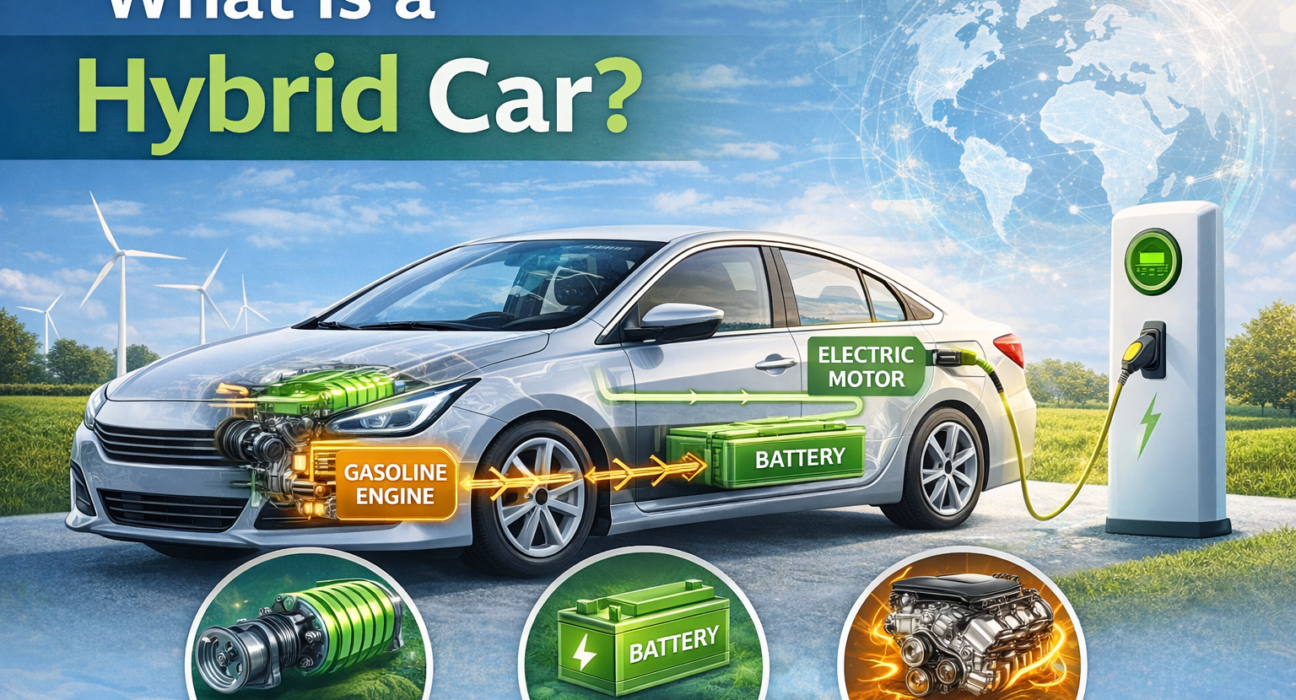
Go into any car showroom, nowadays the salesperson will plunge three or four terms like self-charging hybrid, mild hybrid, strong hybrid, plug-in hybrid, at you. They all sound similar. They are not.
All types perform differently, fit a different type of driver and influence differently your fuel bill. Making an error of picking the wrong one because a badge puzzled you is a very costly affair when it comes to buying a ₹15-40 lakh. ($15k-$40k)
This is a guide on what a hybrid car is and how each of them functions, and which one would be reasonable in your situation without you needing to know all the technical jargon that most of the auto magazines cover everything with.
What Is a Hybrid Car?
A hybrid car is a hybrid car that is currently powered by both an electric motor and battery in addition to a traditional petrol or diesel engine. The two sources of power act in unison or in some cases, alone to drive the car in accordance with what the moment needs.
The electric motor is applied when the speed is low and the acceleration is not very intensive and the petrol engines are the least efficient. The petrol engine is designed to deal with the highway speeds and heavy loads. This has the advantage of having a superior fuel economy to a pure petrol car without the range anxiety of a fully electric one.
A hybrid battery is self charging. It achieves this by regenerative braking a process whereby the energy that would have been wasted as heat during braking is recaptured and converted back to electricity which is stored in the battery. You do not plug it in. You just drive.
Think of it this way
Your petrol engine is a long distance runner that can work at a sustained effort, but cannot work at on and off. The electric motor is similar to a sprinter that is good in bursting short and responding at an instant. A hybrid will allow every car to do its thing best, depending on what you are doing at that time.
The Three key Hybrid Cars:s
The majority of misunderstandings concerning hybrid cars amount to a single element, namely, the fact that the word hybrid is employed as a blanket term to describe three truly different technologies. The following is what each of them entails.
1. Mild Hybrid (MHEV)
The simplest kind of hybridisation is a mild hybrid. The engine is assisted with a small electric motor which assists the engine in acceleration and in stop-start traffic. Instead, the system uses the energy that is captured when braking and stored in a small battery to decrease the work of the engine.
The most important thing to know about a mild hybrid: it is not able to run on electricity alone. The electric motor does not replace the petrol engine that it just supports. However, without knowing that there is a system in place, the car would have no chance of being known to be a hybrid or not. Mild hybrids do not drive any differently compared to the regular petrol or diesel cars.
A 48 volt MHEV can enhance fuel consumption by 20 percent in a vehicle with a comparable engine that solely uses petrol. That will be saving in the real sense, but it is the least among the three types of hybrids.
India Maruti Suzuki Grand Vitara petrol (Petrol) applies the mild hybrid, as well as the new Brezza. Audi, BMW and Mercedes-Benz also are standard with 48V mild hybrid systems on most new high-end European cars.
Mild Hybrid at a Glance
Needs charging: No
Runs on electricity alone: No
Fuel saving vs petrol: 10 to 20 percent
Best for: Buyers who want modest savings with no change to routine
2. Full Hybrid / Strong Hybrid (HEV)
A strong hybrid, also known as a full hybrid or self-charging hybrid is much further than a mild hybrid. Full hybrids can only travel small distances using electric power only. The combustion engine will automatically be turned to the use of electric-only power provided under the right conditions.
That is the case with the Toyota Innova Hycross, the Toyota Urban Cruiser Hyryder and with the original Toyota Prius. The computer in the car controls the switching of petrol/ electric / combined power so whether you want it to remain in one mode to the next you will have no idea, you will not press any buttons. The petrol engine is concerned with the hard acceleration and highway velocity, and electricity is related to the low speed movement, gentle acceleration, and the coasting. There are even systems that close petrol engine momentarily when on a highway, as a way of conserving more fuel.
The gains on the fuel efficiency are significant. The Toyota Hycross hybrid, as an example, has a mileage of approximately 13-16 kmpl under real-life circumstances compared to the 7-10 kmpl of the petrol only counterpart a difference that translates to a lot with a lot of time.
You never plug it in. Driving and generative braking charge the battery fully. This is why Toyota positions it as a self-charging hybrid which is a correct term, but it is used to imply that the absence of an on-board plug is an advantage over PEVs.
Full Hybrid at a Glance
Needs charging: No
Runs on electricity alone: Yes, short distances at low speeds
Saving of fuel over petrol: 30-50% in city.
Best for: City drivers, families, chauffeur-driven use
3. Plug-in Hybrid (PHEV)
A plug-in hybrid makes use of a petrol engine and electric motors, although the latter do a lot more of the work. It has a charging point which allows it to be charged externally via a charging port, similar to a fully electric car. PHEVs are capable of approximately covering a commute distance with only electricity..
Consider a PHEV as a full hybrid and a significantly bigger battery. An example of this is the present Toyota Prius PHEV, which covers 44 miles on electric power, and the RAV4 PHEV, which is aimed at 50 miles of all-electrical range. The petrol engine can hardly run in the weekday of a person who has a 30-60 km daily commute and can charge the battery at home.
However, when it remains idle, i.e. never gets plugged in, a PHEV just acts like an ordinary full hybrid where the petrol engine does a larger portion of the work, and the fuel consumption benefits are reduced. Another option that is more efficient is a plug-in hybrid in case you have the option to plug into the wall at home and drive no more than 40 miles on a specific day. To the rest of the world, a standard hybrid remains one of the simplest means to use less fuel without having to reorganize your life around the charging stations.
Plug-in Hybrid at a Glance
Needs charging: Yes, to get full electric-only benefit
Runs on electricity alone: Yes, 30 to 80 km depending on model
Fuel saving vs petrol: Up to 60 to 70 percent if charged regularly
Best for: Urban commuters with home charging access
Mild Hybrid vs Full Hybrid vs Plug-in Hybrid
| Feature | Mild Hybrid | Full Hybrid | Plug-in Hybrid |
|---|---|---|---|
| Needs plugging in | No | No | Yes (optional) |
| Electric-only driving | No | Yes, short range | Yes, 30 to 80 km |
| Battery size | Small (48V) | Medium | Large |
| Fuel saving vs petrol | 10 to 20% | 30 to 50% city | Up to 60 to 70% |
| Upfront cost premium | Low | Medium | High |
| Charging needed | None | None | Home or public charger |
| India examples | Grand Vitara, Brezza | Hycross, Hyryder, Camry | Meridian 4xe, MG HS |
Three Things Most Buyers Get Wrong
Myth :"Self-charging hybrid" is a special type
It is not. A normal full hybrid is known as self-charging hybrid. All full hybrids recharge themselves by way of regenerative braking. Toyota coined the term to differentiate its vehicles with plug-in hybrids, and not to characterize a dissimilar technology. All full hybrids are self charging by nature.
Myth : Mild hybrid is more or less the same as full hybrid.
They are quite different. A full hybrid has the capability of switching off the petrol engine and fully switching to electricity at low speeds. A mild hybrid cannot. Identifying the two as hybrid annually when one does not indicate which type is a real misleading information to buyers who are comparing the cars by their various price ranges.
Myth: All hybrids need to be plugged in
Plug-in hybrids only need an external charger. Mild and full hybrids are automatically charged on the road. No cable, no charge point, no change of habit. The hybrid cars sold in India presently are either mild or full hybrid and neither of these types ever require to be plugged into a power point.
The correct question to ask at the showroom.
When a salesperson says "hybrid," always ask: is it Whenever a salesperson mentions the word hybrid, make sure you always inquire: is it a mild, full or plug-in? The solution can transform the way you refuel to the level of saving. Do not go away without knowing what kind you are purchasing.
Which Type Is Right for You?
Buy a mild hybrid if:
- You want small fuel economy with no alteration to your commuting schedule.
- Budget is a consideration and the mild hybrid is the optimum in that model.
- You are primarily on the highway where the electric advantage is least anyway.
Buy a full hybrid if:
- You commute and the electric motor consumes the least amount of fuel in the congested city traffic.
- You desire great savings and no charging infrastructure.
- You intend to keep the car within a period of five years or more.
- You are purchasing a high-quality MPV or sedan and in which full hybrids bear the finest feature packages.
- You have a home charger or reliable workplace charging
- Daily commute is less than 50 km and charge overnight.
- You also take long journeys in which full EV range would be ineffective.
- Hybrid car is of three varieties. Mild hybrid, full hybrid and plug-in hybrid operate in a different way. The very term hybrid does not tell you much of use.
- Mild hybrids conserve 10 to 20 percent fuel without a change of lifestyle. Even in city conditions full hybrids save 30-50 percent without charging. The plug-in hybrids save the most, provided that you actually plug them in.
- To the majority of Indian consumers, a full hybrid will provide the most economical mix of convenience and affordability. You already have one in case you are purchasing a Toyota Hycross, Hyryder or Camry.
Buy a plug-in hybrid if:
The Bottom Line
For a detailed 5-year cost comparison between the Hycross hybrid and its petrol variant, read our Hycross Hybrid vs Petrol breakdown.
Frequently Asked Questions
External charging is only required in plug-in hybrids. Mild and full hybrids have automatic recharge of their batteries by the process of regenerative braking when you drive. You fill up on petrol like usual. It has neither a charging cable, nor a charging point, nor a change to your routine.
Mild hybrid employs a small motor that can help the engine that uses petrol but cannot run on electricity. A full hybrid contains a bigger battery and an even stronger powered motor that has the ability to entirely substitute the petrol engine during low speed levels. A full hybrid has much greater fuel savings of 30 to 50 percent in city driving compared to 10 to 20 percent with a mild hybrid.
The regenerative braking retrieves energy when decelerating. Rather than wasting that energy as heat by the brake pads the electric motor operates in reverse and serves as a generator, changing movement back into electricity stored in the battery. That is the way a plugless mild and full hybrids charge themselves.
In full hybrids, the Toyota Innova Hycross and Urban Cruiser Hyryder strong hybrid are the most powerful ones as they give 13-18 kmpl in the real world. In the case of mild hybrids with a lower price offering, the Maruti Grand Vitara and Brezza have strong value propositions. Plug-in hybrids are still a niche in India with the Jeep Meridian 4xe on sale at an extreme price.
Hybrids operate on the highway but do not provide much less in terms of savings than in urban conditions. The petrol engine will be used most of the time and the electric motor will play a minor part at sustained speeds. Its benefit is greatest in stop and go urban traffic. In that case when the majority of your driving is on long highways, then a hybrid will save you fuel over petrol but the savings over the extra cost of buying a hybrid will take longer.